 Phone Cases, Tablet Cases, Screen Protection, Apple Accessories & Peripherals
The Future Development Prospects of Wireless Chargers Combined with Other Products
View:604 Category:News
Combining wireless chargers with other products is not only a current hotspot but also an inevitable trend in the development of future technological living. Its development prospects are extremely broad, which can be analyzed in depth from the following dimensions:
I. Core Drivers: Why is “Integration” the Future?
A standalone wireless charger is merely a “replacement” (for cables), but when combined with other products, it evolves into a “value-added platform” and “service gateway.” The core drivers are:
1. Spatial Efficiency and Aesthetic Demand: Modern living and office spaces are increasingly precious and emphasize simplicity. Multi-functional, integrated furniture and equipment maximize space utilization and align with a minimalist, wireless aesthetic.
2. Scenario-Based Experience Upgrade: Charging occurs in specific scenarios (e.g., bedside, desktop, car, public spaces). Seamlessly embedding charging functionality into the infrastructure of these scenarios provides a more natural and unobtrusive user experience.
3. Ecological System and Data Gateway: For brands (like Apple, Xiaomi, Huawei), integrated charging devices are another link in building a smart ecosystem, capable of collecting user data and enhancing user stickiness.
II. Main Product Integration Directions and Development Prospects
1. Integration with Furniture and Home Environments (Prospects: ★ ★ ★ ★ ★)
This is one of the most promising directions, aiming to make charging “disappear” into the environment.
Specific Forms:
Smart Nightstands/Side Tables: Surfaces with integrated charging zones, potentially also incorporating USB ports, night lights, and Bluetooth speakers.
Desks/Conference Tables: Charging anywhere on the desktop or in specific areas, eliminating the need for a charging pad. Can link with smart office systems to activate personal work modes upon charging.
Sofas/Armrests: Integrated charging zones in sofa armrests or sides for convenient charging while resting in the living room.
Kitchen Countertops/Cabinets: Providing convenient charging points for kitchen appliances (e.g., smart scales, food processors).
Development Prospects: With the popularization of refined apartments and whole-house smart systems, “pre-installed” wireless charging will become a standard feature in high-end homes. Collaboration between furniture manufacturers and tech companies will become increasingly close.
2. Functional Integration with Consumer Electronics (Prospects: ★ ★ ★ ★ ☆)
Adding wireless charging as an additional feature to existing electronic products to enhance their value.
Specific Forms:
Smart Speakers/Smart Displays: Charging phones at the base or top, becoming a home information and energy hub.
Laptops (especially monitors): Apple’s Studio Display has set a precedent by integrating charging into the stand. In the future, laptop palm rests or sides might also charge mice or headphones.
Gaming Equipment: Wireless charging integrated into game controller docks, VR headset stands.
Development Prospects: This has become a “sweetener” feature for mid-to-high-end electronics, effectively enhancing product competitiveness. It is expected to rapidly proliferate across more product categories.
Office Equipment: Laptop sleeve, mouse pad, notebook.
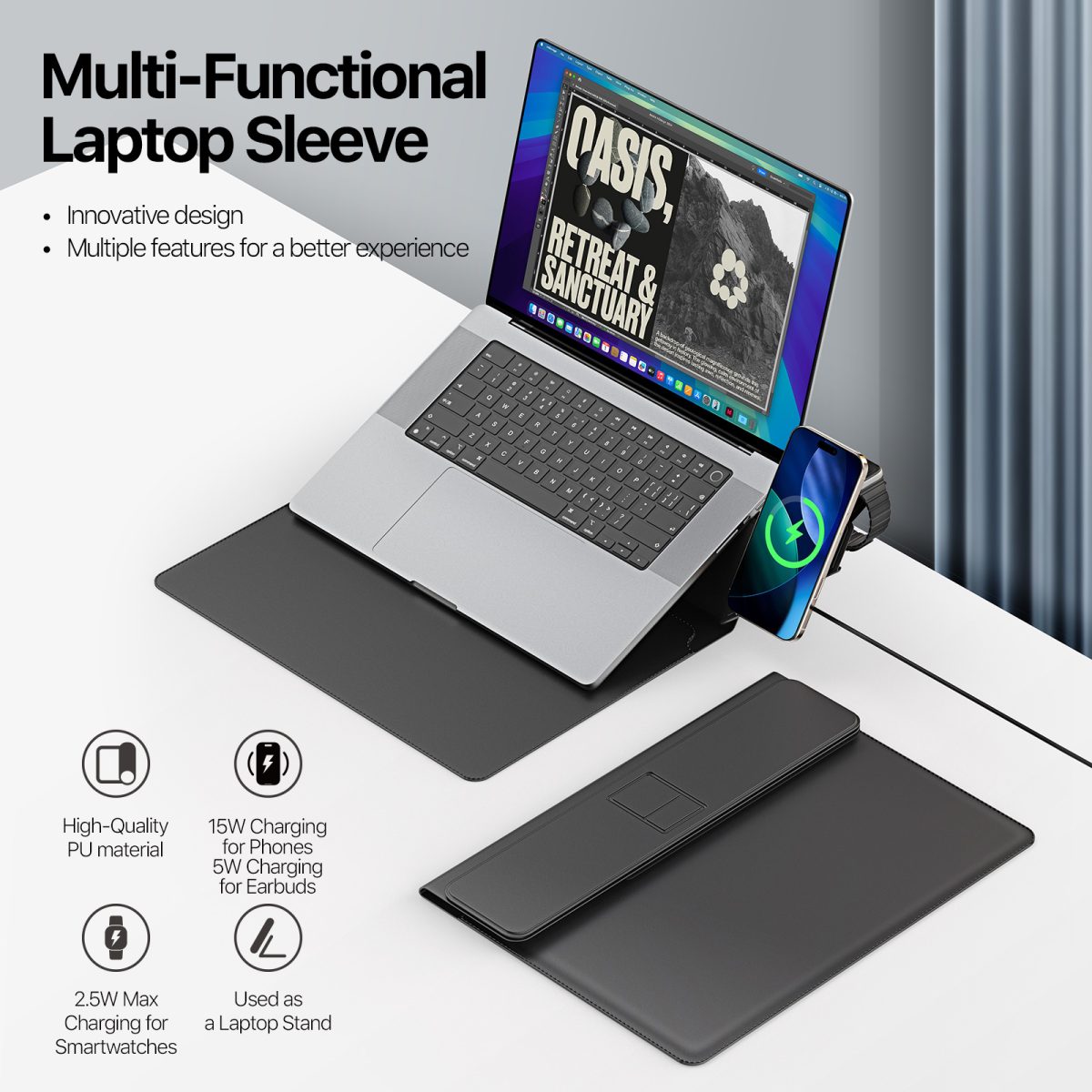
3. Deep Integration in Automotive Interiors (Prospects: ★ ★ ★ ★ ★)
The car is one of the most natural application scenarios for wireless charging.
Specific Forms:
Center Console/Armrest Box: Now a standard feature in new cars for charging phones.
Rear Seats/Door Panels: Charging devices for rear-seat passengers.
Future Forms: Charging tablets, or even laptops, inside the car. As autonomous driving matures and the car interior becomes a “mobile living space,” wireless charging will be ubiquitous.
Development Prospects: In-vehicle wireless charging will become a standard feature in all new cars, expanding from single phone charging to powering all portable devices within the vehicle.
4. Integration as Public Infrastructure (Prospects: ★ ★ ★ ★ ☆)
Offering wireless charging as a public service to enhance a venue’s appeal and modern image.
Specific Forms:
Tables in Cafes/Restaurants: Wireless charging embedded in the tabletop.
Seats, Check-in Counters at Airports/Train Stations: Convenient charging while waiting.
Nightstands, Desks in Hotel Rooms: Becoming a standard feature of smart rooms.
Information Kiosks, Lounge Areas in Shopping Malls.
Development Prospects: Similar to Wi-Fi in its day, it will transition from a value-added service to essential infrastructure in high-end public spaces. Business models like “free charging to attract consumption” may emerge.
5. Innovative Combination with New Form-Factor Devices (Prospects: ★ ★ ★ ★ ☆)
Exploratory directions aimed at the future.
Specific Forms:
Robot/Drone Charging Docks: Automatic return and charging, enabling fully unmanned operation.
AR/VR Device Docks: Simultaneous data syncing and charging.
Wearable Device Charging Cases: Integrating charging for watches and headphones into a portable case with its own power bank.
III. Challenges and Future Trends
Challenges:
1. Standardization: Although the Qi2 standard is gradually being adopted, fast-charging protocols still vary by brand, affecting the optimal experience.
2. Charging Efficiency & Heat Dissipation: Integrated products place higher demands on structural design. Poor heat dissipation can lead to slow charging speeds or even safety hazards.
3. Cost Issues: Integration increases initial costs and selling prices.
4. Technical Bottlenecks: Breakthroughs are still needed for long-distance, high-power, and multi-device simultaneous charging technologies.
Future Trends:
1. Unobtrusive and Ubiquitous: Charging will be like air—everywhere and without deliberate action. You simply place your device on a table or sofa, and it charges.
2. Technology Convergence: “Wireless Charging +” will become the norm, integrating with technologies like the Internet of Things (IoT), Artificial Intelligence (AI), and Ultra-Wideband (UWB). For example, when a device is placed down to charge, AI could automatically adjust room lighting and volume.
3. Energy Management Platform: Wireless charging networks in homes will link with solar power and energy storage systems to enable smart energy distribution.
4. Eventual Standard Unification: With industry development and potential regulation, fast-charging standards will move towards unification, providing a seamless user experience.
Conclusion
The future development prospects for wireless chargers combined with other products are exceptionally bright. They are transitioning from a standalone “functional product” to an ubiquitous “fundamental capability.” Their development path will move from “functional add-on” to “scenario integration,” ultimately achieving “environmental empowerment.” For businesses and entrepreneurs, this contains huge market opportunities and space for innovation. Those who can better and more elegantly integrate the charging experience seamlessly into the specific life scenarios of users will hold a competitive advantage in the future.